
How Long for Xanax to Kick In? A Patient’s Guide
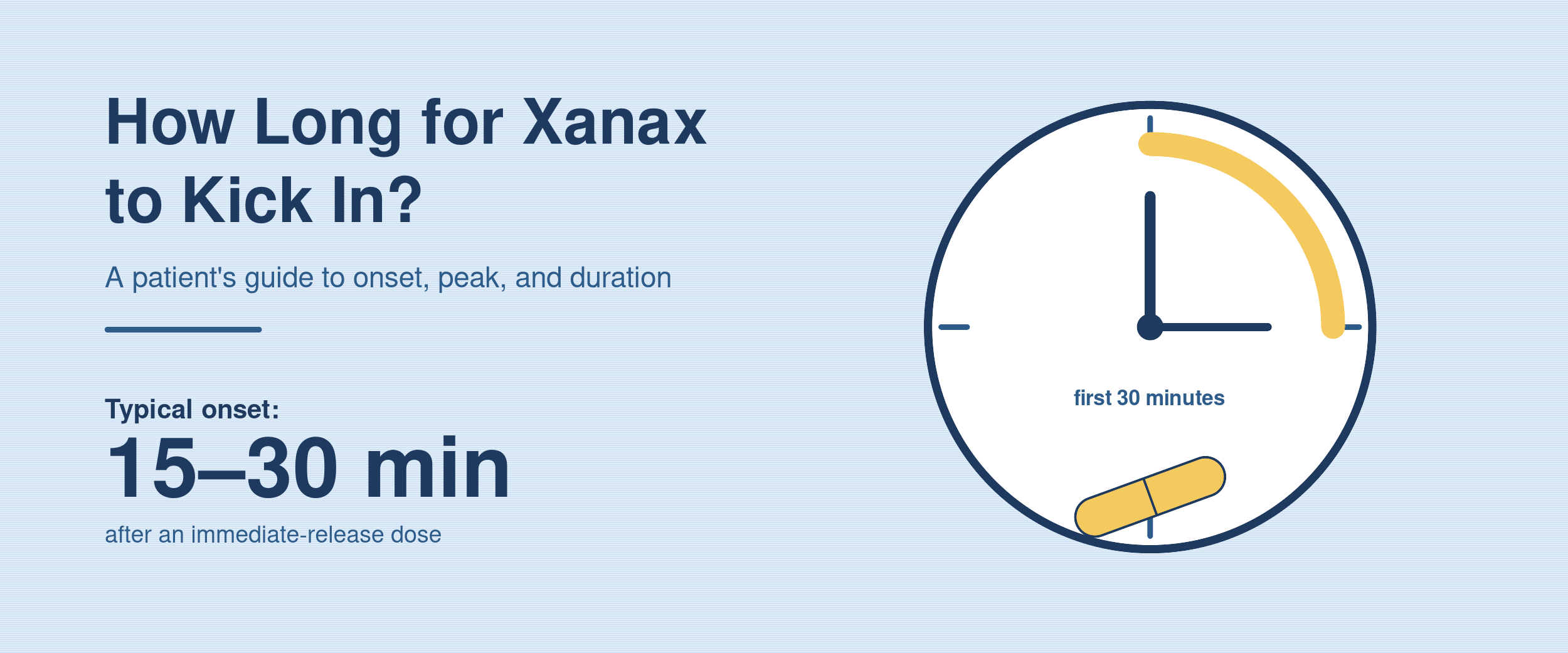
If you’ve just been prescribed Xanax (alprazolam) or are considering taking it for the first time, one of the most common questions is simple: how long before it actually starts to work? The short answer is that most people begin to feel the effects within 15 to 30 minutes of swallowing an immediate-release tablet, with the strongest effects usually arriving around the one-hour mark. But the full picture is more nuanced. Onset depends on the formulation you’re taking, what’s in your stomach, your individual metabolism, and several other factors worth understanding.
This guide walks through how long does it take Xanax work, what affects how quickly it kicks in, how long the effects last, and what to keep in mind for safer use. None of this is a substitute for medical advice from the clinician who prescribed it to you.
How Xanax Works in the Body
Xanax is the brand name for alprazolam, a short-acting benzodiazepine prescribed primarily for anxiety disorders and panic disorder. It works by enhancing the effect of a neurotransmitter called GABA, which calms overactive signaling in the brain. The result is reduced anxiety, muscle relaxation, and a sense of sedation.
The blue Xanax pill is well absorbed from the gastrointestinal tract; it reaches the bloodstream relatively quickly compared to many other anti-anxiety medications. That’s part of the reason it’s often prescribed for acute, situational anxiety or panic attacks rather than as a daily long-term treatment.
How Long Does It Take to Kick In?
For the standard immediate-release tablet, most people start to notice effects within 15 to 30 minutes after taking the dose. Peak blood concentration, where the effect is strongest, typically occurs about 1 to 2 hours after swallowing the pill.

Approximate timeline of effect for an immediate-release Xanax dose.
The extended-release version (Xanax XR) is designed to release alprazolam slowly over time. It still begins entering the bloodstream within the first hour, but you generally won’t feel a noticeable “kick-in” moment the way you might with the immediate-release form. Peak levels with XR typically occur around 9 hours after dosing, and it’s designed for sustained coverage rather than fast relief.
Orally disintegrating tablets (the brand Niravam, for example) dissolve on the tongue. While this feels faster, the medication still has to be absorbed through the digestive tract, so the onset is similar to a regular tablet — roughly 15 to 30 minutes.
What Affects How Quickly Xanax Kicks In
Several factors influence how fast you’ll feel the effects:
- Food in your stomach: Taking Xanax on an empty stomach generally leads to faster absorption. A high-fat meal can delay peak concentration, though it doesn’t usually reduce the total amount absorbed.
- Formulation: Immediate-release tablets work faster than extended-release. If your prescription is XR, don’t expect a rapid onset — that’s by design.
- Metabolism and age: Younger adults with healthy liver function tend to process alprazolam faster. Older adults and people with liver impairment metabolize it more slowly, which can prolong both onset perception and overall effects.
- Body weight and composition: These can subtly affect how the drug distributes through the body, though dose adjustments by a clinician usually account for this.
- Other medications: Certain drugs (some antifungals, antibiotics, and oral contraceptives, for example) can slow alprazolam’s breakdown, intensifying or extending effects. Grapefruit juice can do the same.
- Tolerance: People who have taken benzodiazepines regularly may notice a less pronounced effect at the same dose. This is a sign worth discussing with your prescriber, not something to manage by increasing your own dose.
Comparison With Other Benzodiazepines
Xanax is one of several benzodiazepines, and each has its own onset and duration profile.
Xanax vs Valium
Valium (diazepam) generally kicks in within 15 to 60 minutes when taken orally, but it has a very long half-life — often a full day or more once its active metabolites are included — making it better suited for sustained effects than fast relief.
Klonopin vs Xanax
Klonopin (clonazepam) starts working in roughly 20 to 60 minutes and lasts considerably longer than Xanax, with a half-life around 30 to 40 hours, which is why it’s often used for ongoing anxiety or seizure control rather than acute panic.
Ativan vs Xanax
Ativan (lorazepam) has an oral onset similar to Xanax — about 20 to 30 minutes — but with a more moderate half-life of around 12 hours, giving it a middle-ground profile.
Farmapram is worth a special mention: it’s a Mexican brand name for alprazolam, the same active ingredient as Xanax, so its onset and effects are essentially identical. Because Farmapram is sometimes purchased outside a prescriber’s care, however, there is a real risk of counterfeit pills containing dangerous substances like fentanyl — only take alprazolam (under any brand name) that comes from a licensed pharmacy.
How Long Do the Effects Last?
The noticeable anti-anxiety effects of an immediate-release dose usually last around 4 to 6 hours, though some people feel residual calmness or drowsiness longer than that. The drug’s half-life — the time it takes your body to clear half a dose — averages about 11 hours in healthy adults, which means it can still be measurable in your system for a full day or more even after you stop feeling its effects.
For Xanax XR, the dosing is typically once daily because the medication is released slowly throughout the day.
Tips for Taking Xanax as Prescribed
- Take it exactly as your clinician directed — don’t adjust your own dose or timing.
- If you take it for a panic attack, give it the full 15 to 30 minutes to start working before assuming it isn’t enough.
- Avoid alcohol while taking Xanax. The combination can dangerously suppress breathing.
- Be cautious with opioids and other sedatives — these combinations carry a significant risk of respiratory depression and overdose.
- Skip the grapefruit juice, which can raise alprazolam levels unpredictably.
- Don’t drive or operate machinery until you know how the medication affects you.
When to Talk to Your Doctor
Reach out to your prescriber if Xanax doesn’t seem to be working at the expected time; if effects feel much stronger or weaker than usual; if you experience confusion, memory problems, or unusual mood changes; or if you find yourself needing to take it more often than prescribed. Stopping benzodiazepines suddenly after regular use can cause significant withdrawal symptoms, including seizures, so any change to your routine should be coordinated with a clinician.
Frequently Asked Questions
Can putting Xanax under my tongue make it work faster?
Not really. Alprazolam isn’t well absorbed through the lining of the mouth, so it still has to be swallowed and absorbed in the gut to take effect. Holding a tablet sublingually doesn’t reliably speed up onset and may just leave a bitter taste. Take it as directed instead.
How long does Xanax stay in my system?
The drug’s half-life averages about 11 hours, which means it can take roughly 2 to 4 days for most of a dose to clear. Standard urine drug tests can detect alprazolam for around 4 to 5 days after the last dose, while hair tests can detect it for much longer. Individual results vary based on dose, frequency of use, age, and metabolism.
Why doesn’t my usual Xanax dose seem to work anymore?
Regular use of benzodiazepines can lead to tolerance, where the same dose produces less effect over time. This is common and is not a sign that you should increase the dose on your own. Talk to your prescriber — they may adjust your treatment plan, consider a different medication, or look at non-medication strategies for anxiety.
Is it safe to drink coffee or other caffeine while taking Xanax?
A normal amount of caffeine is usually fine, but caffeine is a stimulant that can blunt Xanax’s calming effect and may worsen anxiety symptoms. If you’re taking Xanax for panic or anxiety, heavy caffeine intake can work against you. Notice how your body responds and consider cutting back if needed.
Can I take Xanax for sleep?
Xanax is sometimes used short-term for insomnia related to anxiety, but it isn’t a first-choice sleep medication. Benzodiazepines can disrupt natural sleep architecture, and using them nightly carries dependence risk. If sleep is the main concern, ask your clinician about safer long-term options.
What should I do if I miss a dose?
If it’s close to the time of your missed dose, take it when you remember. If your next scheduled dose is coming up soon, skip the missed one — don’t double up. For panic-attack or as-needed use, simply take it when symptoms occur, as directed.
Can Xanax be taken during pregnancy or while breastfeeding?
Generally no. Alprazolam can cross the placenta and is associated with risks in pregnancy, and it’s also passed into breast milk. If you’re pregnant, planning pregnancy, or breastfeeding, talk to your doctor about safer alternatives before continuing or starting Xanax.