
Pain Behind the Knee, Left Arm Pain, and Lower Back Pain
Your body speaks through pain. The location, character, and timing of pain are its language — and knowing how to interpret those signals can mean the difference between catching a serious condition early and missing a critical warning sign.
Three of the most commonly reported pain locations — behind the knee, in the left arm, and in the lower back — are also three of the most frequently misunderstood. Each can range from completely benign to genuinely life-threatening, depending on the accompanying symptoms and clinical context. This guide decodes what each of these pain locations typically means, when you need to act urgently, and what treatment options are available.
Pain Behind the Knee: Causes, Diagnosis, and When It Signals a Serious Condition
The posterior knee — the area behind the kneecap and knee joint — is a structurally complex region containing major blood vessels, lymph nodes, nerves, tendons, ligaments, and the popliteal fossa (the soft tissue pocket behind the knee joint). Pain in this area can arise from any of these structures, making accurate diagnosis essential.
Most Common Causes of Pain Behind the Knee
- Baker's cyst (popliteal cyst): The most frequent cause of posterior knee pain in adults. A Baker's cyst is a fluid-filled sac that develops behind the knee, usually as a secondary response to joint inflammation from arthritis or a meniscal tear. It presents as a soft, sometimes tender bulge behind the knee that worsens with activity.
- Posterior cruciate ligament (PCL) injury: The PCL prevents the tibia from sliding backward and is commonly injured in dashboard-impact car accidents or direct falls onto a flexed knee. PCL tears cause pain, instability, and swelling in the posterior knee region.
- Meniscal tears: Tears in the medial or lateral meniscus can cause pain that localizes to the back of the knee, particularly during twisting movements or full knee flexion.
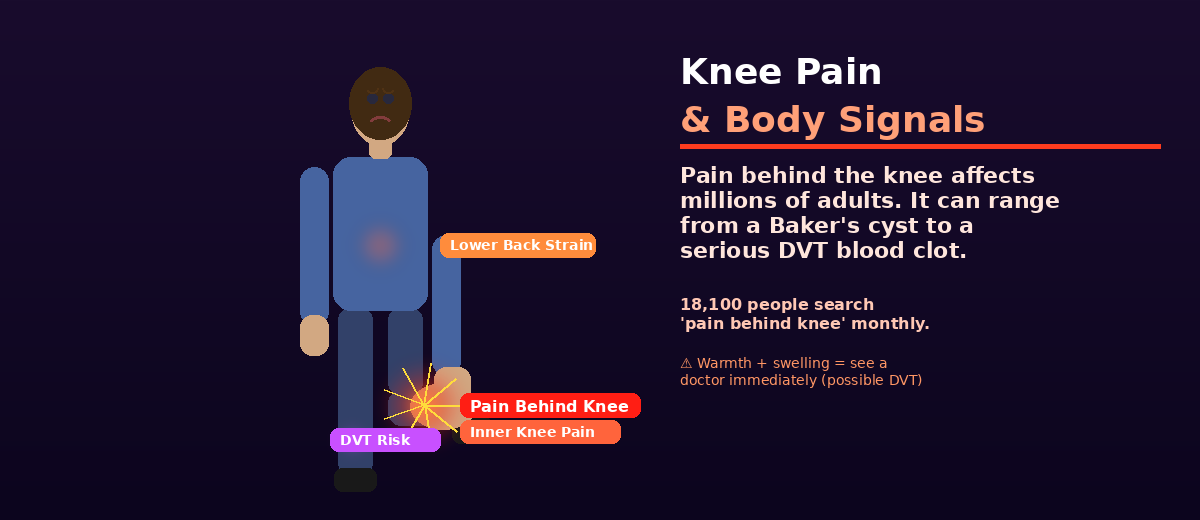
- Deep vein thrombosis (DVT): A blood clot forming in the deep veins of the calf or popliteal region presents as calf and posterior knee pain, warmth, swelling, and redness. DVT is a medical emergency — clots can break free and travel to the lungs, causing pulmonary embolism.
- Hamstring tendinopathy: The hamstring tendons attach to the posterior aspect of the knee. Overuse, sudden acceleration, or inadequate recovery can cause tendon inflammation and pain in the posterior knee region during activity.
- Osteoarthritis: Advanced knee arthritis causes diffuse joint pain that frequently includes the posterior compartment, particularly with full flexion or extension.
Red Flag Symptoms: When Pain Behind the Knee Is an Emergency
Seek immediate medical evaluation if posterior knee pain is accompanied by sudden severe swelling, significant warmth and redness, calf pain with or without swelling (possible DVT), fever, inability to bear weight, or a palpable pulsing lump (possible popliteal artery aneurysm). These presentations require urgent vascular or orthopedic assessment.
Left Arm Pain: Why Location Matters and When It Could Be Your Heart
Left arm pain is one of the most anxiety-provoking symptoms a person can experience — and with good reason. While the majority of left arm pain cases have musculoskeletal or neurological causes, pain in the left arm is also a recognized warning sign of acute myocardial infarction (heart attack) and should never be dismissed without proper evaluation.

Cardiac Causes of Left Arm Pain: What to Watch For
During a heart attack, pain signals from the myocardium are processed by the same spinal segments that receive sensory input from the left arm. This neurological overlap — called referred pain — explains why heart attack pain so frequently radiates into the left arm, shoulder, jaw, or neck. Left arm pain that may indicate a cardiac emergency typically:
- Presents as pressure, squeezing, or heaviness: Rather than sharp or pinpoint pain.
- Radiates from the chest or shoulder: Moving down the arm rather than originating locally.
- Is accompanied by chest pain, shortness of breath, sweating, nausea, or lightheadedness: These accompanying symptoms significantly elevate the urgency of evaluation.
- Comes on during physical exertion or emotional stress: Though it can also occur at rest.
If you experience left arm pain with any of the above features, call emergency services immediately. Do not drive yourself to the hospital.
Non-Cardiac Causes of Left Arm Pain
- Cervical radiculopathy: Compression of nerve roots in the cervical spine (neck) — typically at C6 or C7 — produces pain, numbness, or tingling that radiates down the left arm. This is one of the most common non-cardiac causes of left arm pain.
- Shoulder pathology: Rotator cuff tears, tendinitis, bursitis, and shoulder impingement can all generate pain that extends down the upper left arm.
- Thoracic outlet syndrome: Compression of nerves or blood vessels between the collarbone and first rib causes pain, tingling, and weakness in the arm and hand.
- Peripheral neuropathy: Nerve damage from diabetes or other systemic conditions can produce burning or tingling pain in one or both arms.
- Musculoskeletal strain: Overexertion, repetitive strain, or direct trauma to the left arm muscles produces localized aching pain that is typically activity-related and reproduced with palpation.
Lower Back Pain: A Comprehensive Guide to the Most Common Cause of Disability Worldwide
Low back pain is the single leading cause of disability globally, affecting an estimated 619 million people worldwide. It accounts for more lost workdays and healthcare visits than virtually any other musculoskeletal condition. Despite its prevalence, lower back pain is frequently undertreated, misdiagnosed, or managed with approaches that fail to address the underlying mechanisms driving the pain.
Primary Causes of Lower Back Pain
- Lumbar muscle strain and ligament sprain: The most common acute cause of lower back pain, typically resulting from sudden movement, heavy lifting, or prolonged poor posture. Pain is usually localized, worsens with movement, and resolves within 4–6 weeks with appropriate management.
- Lumbar disc herniation and sciatica: When the inner gel of a spinal disc protrudes and compresses an adjacent nerve root, it produces lower back pain that radiates down one leg — classically described as sciatica. Pain follows the path of the compressed nerve and may be accompanied by numbness, tingling, or leg weakness.
- Lumbar spinal stenosis: Narrowing of the spinal canal in the lower back compresses the nerve roots and spinal cord, producing bilateral leg pain, heaviness, and cramping that worsens with walking and is relieved by sitting or bending forward — a pattern called neurogenic claudication.
- Degenerative disc disease: Progressive loss of disc height and hydration reduces shock absorption and destabilizes the lumbar spine, causing deep, aching lower back pain that varies with activity and position.
- Sacroiliac joint dysfunction: Inflammation or instability of the SI joint produces one-sided lower back and buttock pain that may mimic sciatica but typically does not radiate below the knee.
Personalized Relief Options Including Compounded Topical Therapy
For patients with lower back pain that has not responded adequately to standard treatments, compounded topical analgesics offer targeted relief with minimal systemic side effects. A licensed compounding pharmacist can formulate a transdermal cream combining agents such as diclofenac, cyclobenzaprine, gabapentin, and lidocaine — delivering multi-mechanism pain relief directly to the lumbar region. These preparations are particularly valuable for patients who cannot tolerate oral NSAIDs due to gastrointestinal issues, cardiovascular risk, or drug interactions.
Conclusion: Pain Is a Signal — Listen to What Each Location Is Saying
Pain behind the knee, pain in the left arm, and lower back pain are three of the most common — and most clinically significant — pain presentations in adults. What unites them is the critical importance of not dismissing any of these symptoms as routine without proper evaluation, particularly when they are severe, sudden, persistent, or accompanied by other warning signs.
Frequently Asked Questions
Q: What does pain behind the knee indicate?
A: Pain behind the knee most commonly indicates a Baker's cyst, meniscal tear, hamstring tendinopathy, or early arthritis. However, it can also signal deep vein thrombosis (DVT) — a blood clot requiring urgent medical evaluation. If posterior knee pain is accompanied by warmth, redness, and calf swelling, seek immediate care.
Q: Is left arm pain always related to the heart?
A: No. While cardiac-related left arm pain is the most serious possibility and should always be ruled out, the majority of left arm pain cases are caused by cervical nerve root compression, shoulder pathology, or musculoskeletal strain. However, any left arm pain accompanied by chest discomfort, shortness of breath, sweating, or nausea should be treated as a potential cardiac emergency.
Q: What causes sudden lower back pain on the right side?
A: Sudden lower right back pain is most commonly caused by muscle strain, lumbar disc herniation, or SI joint dysfunction. It can also indicate kidney stones or a kidney infection. If the pain is severe, accompanied by fever, or associated with urinary symptoms, seek medical evaluation promptly.
Q: When should I go to the ER for back pain?
A: Go to the emergency room for back pain if you experience sudden loss of bowel or bladder control, severe progressive leg weakness or numbness, back pain following significant trauma, fever with back pain, or severe unrelenting pain that does not improve with rest or position change.
Q: Can left arm pain be caused by a pinched nerve in the neck?
A: Yes. Cervical radiculopathy — compression of nerve roots in the neck at levels C5 through C8 — is one of the most common causes of non-cardiac left arm pain. It typically causes radiating pain, numbness, or tingling from the neck down the arm, and is often accompanied by neck stiffness.
Q: What are the best treatments for chronic lower back pain?
A: Evidence-based treatments for chronic lower back pain include physical therapy, graded exercise, cognitive behavioral therapy, NSAIDs or muscle relaxants for acute flares, epidural steroid injections for nerve-related pain, and compounded topical analgesics for patients who cannot tolerate systemic medications.
Most cases will have benign, treatable causes. But knowing which symptoms demand urgent attention — the DVT risk behind your knee, the cardiac pattern in your left arm, the neurological red flags in your lower back — could save your life or prevent permanent disability.
If you are managing chronic pain in any of these regions and standard medications have not provided adequate relief, our compounding pharmacy team can work with your physician to create a personalized pain management formulation designed specifically for your condition and tolerability profile.